Call: 07886 045515 | talk@rozscounsellingcorner.co.uk
Why Do We Struggle to Set Boundaries?
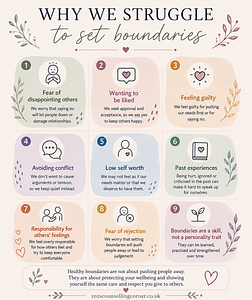
Boundary guilt and people pleasing are two of the most common reasons people struggle to set healthy boundaries. If you are finding it difficult to say no, prioritise your own needs, or speak up for yourself, you are not alone.
Healthy boundaries are often misunderstood. Setting boundaries is not about being selfish, difficult, or pushing people away. Instead, boundaries help protect our wellbeing, support healthy relationships, and allow us to care for ourselves as well as others.
As a counsellor in Ross-on-Wye, I often work with people who know they need stronger boundaries but find themselves repeatedly putting other people’s needs before their own.
Fear of Disappointing Others
One of the most common reasons people struggle to set boundaries is a fear of letting others down.
Many of us learn from an early age that being helpful, agreeable, or accommodating is valued. As adults, this can make it difficult to say no, even when we feel overwhelmed or exhausted.
We may worry that setting a boundary will damage a relationship or cause someone to think differently about us.
Wanting to Be Liked
The desire to be accepted is a natural part of being human.
When we are struggling to set boundaries, we may find ourselves saying yes to things we do not want to do because we fear rejection or judgement.
People pleasing can feel like a way of maintaining connection, but over time it can leave us feeling resentful, drained, and disconnected from our own needs.
Why Boundary Guilt Happens
Many people experience boundary guilt when they begin making changes.
You might feel guilty for turning down a request, taking time for yourself, or prioritising your own wellbeing. This guilt can be especially strong if you have spent years putting others first.
However, feeling guilty does not necessarily mean you are doing something wrong. Often it simply means you are doing something different.
Avoiding Conflict
Some people associate boundaries with confrontation.
If you grew up around arguments, criticism, or unpredictable reactions, avoiding conflict may have become a way of keeping yourself safe.
As a result, staying quiet can feel easier than expressing your needs. Unfortunately, avoiding difficult conversations often creates more frustration and emotional strain in the long term.
Low Self Worth and Boundaries
Our relationship with ourselves can have a significant impact on our ability to set healthy boundaries.
When self worth is low, we may question whether our needs matter. We may believe other people’s feelings are more important than our own or that we do not deserve support, rest, or respect.
Learning to value ourselves can make boundary setting feel more natural and less frightening.
How Past Experiences Can Affect Boundaries
Past experiences often influence how comfortable we feel speaking up for ourselves.
If your feelings were dismissed, criticised, ignored, or minimised growing up, you may have learned that expressing your needs is unsafe or unwelcome.
These experiences can continue into adulthood, affecting friendships, family relationships, and romantic partnerships.
Understanding where these patterns come from can be an important step towards changing them.
Fear of Rejection
Many people who are struggling to set boundaries worry that others will leave, become angry, or stop caring about them.
This fear can keep us stuck in patterns that no longer serve us.
While some relationships may need to adjust when boundaries change, healthy relationships are usually able to adapt and grow. People who genuinely care about you often want to understand your needs, even if it takes time.
Boundaries Are a Skill, Not a Personality Trait
Some people believe that confident people naturally know how to set boundaries.
In reality, boundaries are a skill that can be learned, practised, and strengthened over time.
Like any new skill, boundary setting may feel uncomfortable at first. The more opportunities you have to practise, the more confident you are likely to become.
Small changes can make a significant difference. A simple “not today”, “I need some time to think about that”, or “I am unable to commit to that right now” can be a powerful starting point.
How Counselling Can Help
If you are struggling to set boundaries, counselling can provide a safe and supportive space to explore what might be getting in the way.
Together, we can look at the patterns, experiences, and beliefs that make boundary setting difficult. We can also explore practical ways of communicating your needs while maintaining healthy relationships.
I offer counselling in Ross-on-Wye for adults, young people, and couples, both face-to-face and online.
For further information about emotional wellbeing, the NHS provides helpful guidance on mental health support: NHS.
Looking for Support?
If this resonates, or you are looking for support for your child, young person, or yourself, feel free to get in touch.